
Socialism vs. Communism: How Are They Actually Different?
Dale Porter · September 13, 2026 · 4 min read
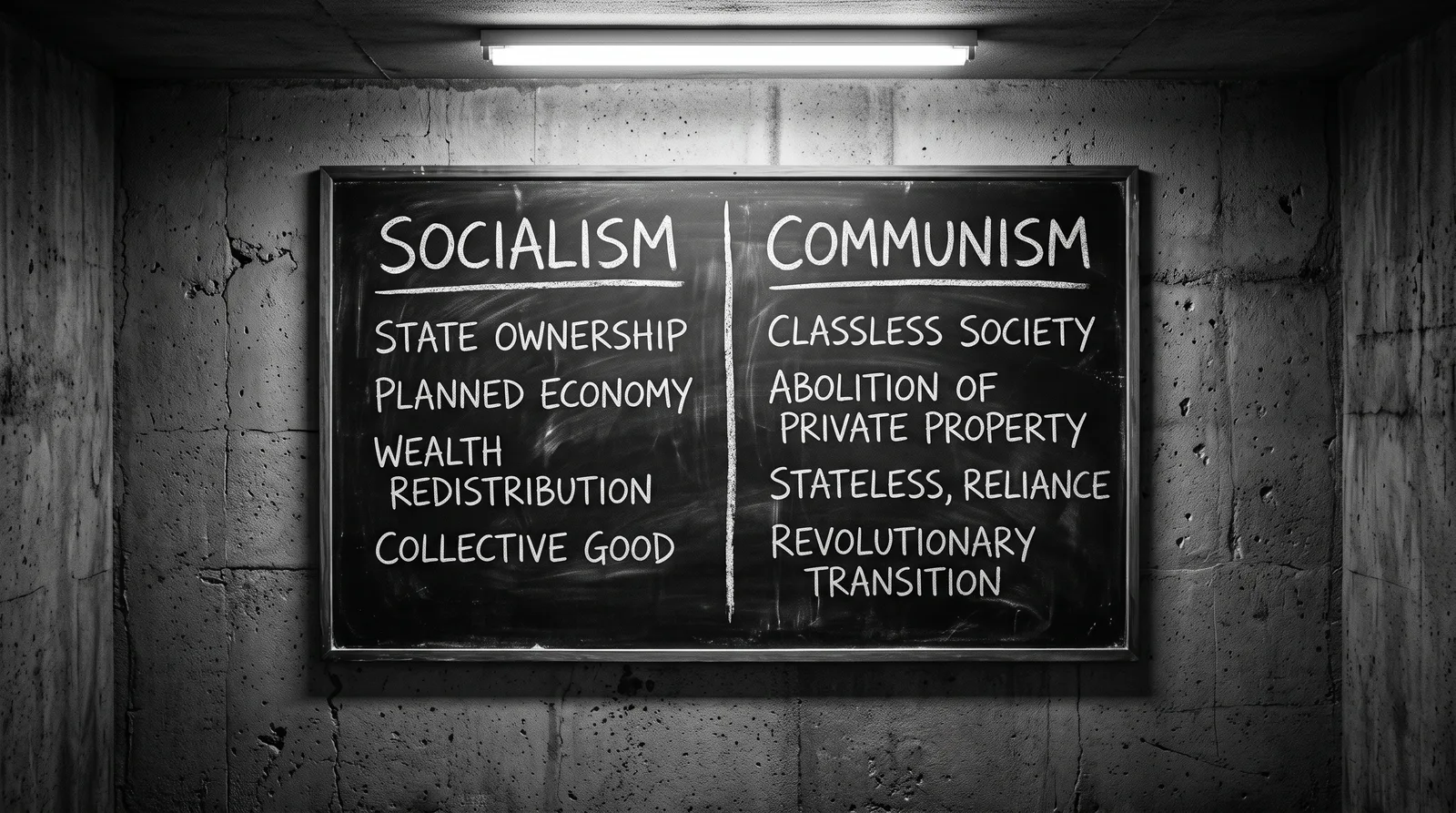
Turn on cable news for twenty minutes and you'll hear both words used as if they're interchangeable insults — or interchangeable compliments, depending on the channel. But socialism and communism are not the same thing. They share some DNA, they've been confused for decades, and that confusion costs people the ability to think clearly about some of the most important questions in political life.
Let's fix that right now. No jargon. No polemics. Just the actual differences.
Start With the Same Root
Both systems are responses to the same basic question: Who should own the means of production? "Means of production" is economist-speak for the factories, farms, resources, and businesses that generate wealth in a society. Classical liberal economics says private individuals should own them. Both socialism and communism push back on that — but they push back in very different ways and stop at very different places.
What Socialism Actually Claims
Socialism, in its core form, argues that key industries — energy, healthcare, transportation, banking — should be owned or heavily controlled by the public, usually through the government. But it does not demand that all private property disappear. You can still own your home, your car, your small business. The government steps in at the commanding heights of the economy, not every corner of it.
Democratic socialism — the version you hear about most in U.S. politics today — adds another layer: it insists this economic shift should happen through democratic elections, not revolution. Voters choose it. Governments implement it. Future voters can reverse it. Think of it as a heavy-intervention welfare state operating inside a democratic political structure — high taxes, expansive public services, regulated markets.
The key words for socialism: partial collective ownership, democratic process, coexistence with private property.
What Communism Actually Claims
Communism starts where socialism stops and keeps going. It calls for the elimination of private ownership of the means of production — not just regulation of them, not just government partnership, but full collective ownership of essentially everything productive in the economy. The end goal in classical Marxist theory is a classless, stateless society where resources are distributed according to the principle: from each according to his ability, to each according to his needs.
Notice the word "stateless." Pure communist theory envisions the government eventually withering away once class distinctions are erased. In practice, that has never happened. Every government that called itself communist in the 20th century didn't wither — it grew, and it held on to power by force.
The key words for communism: total collective ownership, elimination of class, single-party or authoritarian control in practice, revolutionary rather than electoral transition.
The Three Sharpest Differences
Let's put them side by side where it really counts:
1. Private Property Socialism permits private ownership of personal and small-scale property. Communism, in theory and in most practice, eliminates it at the level of productive assets and often beyond.
2. How Power Changes Hands Democratic socialism operates through elections — you vote it in, you vote it out. Communist governments have historically come to power through revolution and maintained power through single-party rule, with no meaningful electoral check on leadership.
3. The Role of the State Socialism uses a strong state as the tool to manage the economy and redistribute wealth — but the state remains answerable (at least in theory) to voters. Classical communist theory wants the state to eventually disappear, but communist governments in practice have produced some of the most powerful and repressive state apparatuses in history.
Why the Confusion Exists
Part of it is deliberate. Cold War rhetoric on both sides blurred the lines — Western critics called anything left of center "communist," while Soviet propaganda called its system "socialist" on the road to a communist utopia that never arrived. Decades of that cross-talk left most people without a clean vocabulary.
Part of it is also structural: socialism can be a stepping stone to communism in Marxist theory. Marx himself described socialism as the transitional phase between capitalism and full communism. So the two systems are related — they're just not identical, any more than a layover city is the same as your final destination.
Why It Matters for You
If you're going to have an intelligent opinion about economic policy — tax rates, public healthcare, government ownership of utilities, the proper role of markets — you need to know what you're actually talking about. Calling a social safety net "communism" misidentifies the threat. Treating a fully centralized command economy as just "a lot of socialism" understates the difference in kind, not just degree.
Words mean things. Systems have structures. And those structures produce very different outcomes for the people living inside them.
This is exactly the kind of foundational distinction we dig into in Republic vs. Socialism vs. Communism — because you can't defend what you value if you can't define what threatens it.