
How to Read the U.S. Constitution as a Beginner: A Step-by-Step Roadmap
Fraternal Order of Continental Sentinels Constitutional Republic Studies · September 13, 2026 · 4 min read
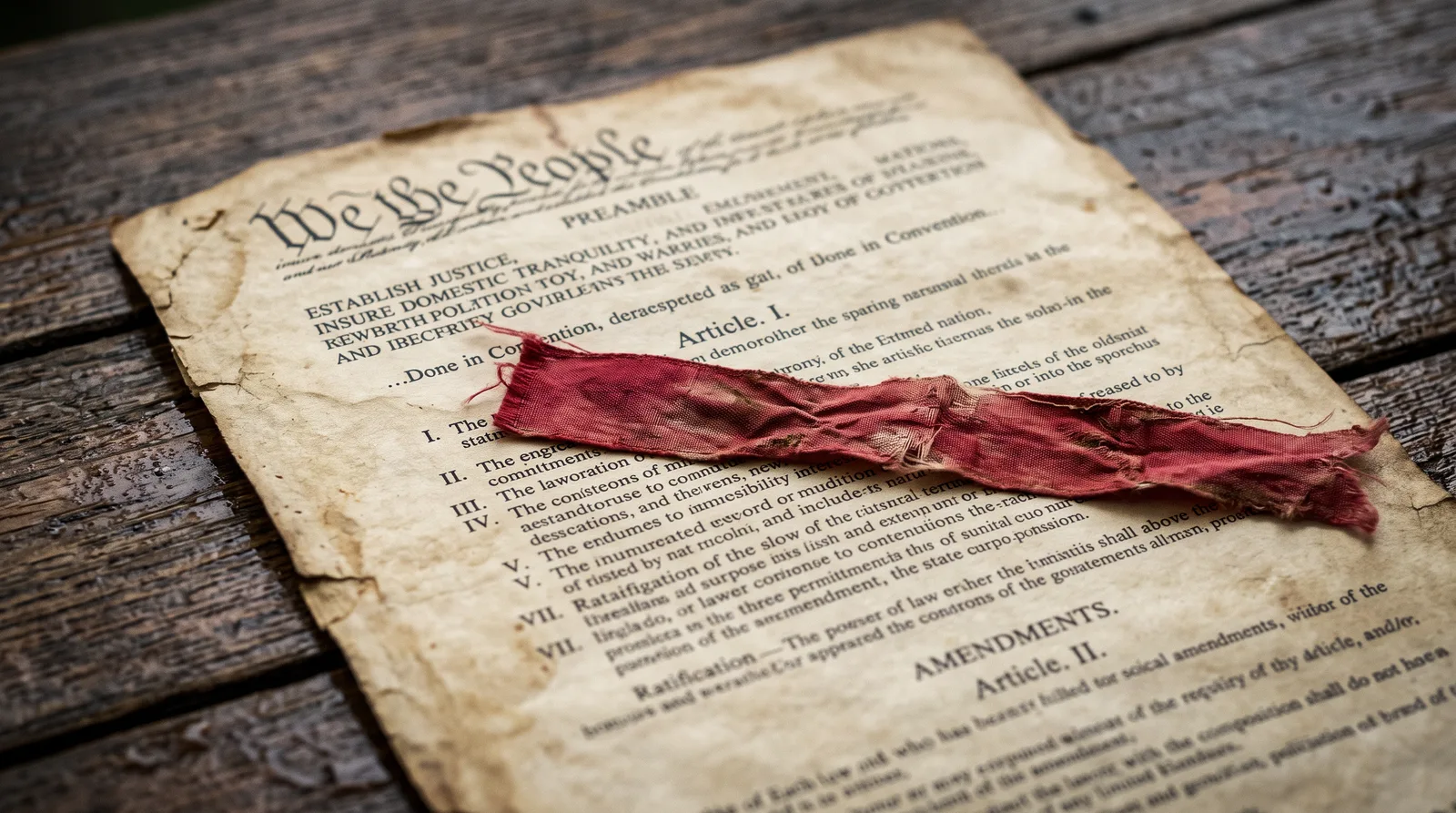
Most people's first encounter with the Constitution is a headline about the Second Amendment or the Commerce Clause — and that's exactly backwards. Here's the logical order that actually builds understanding.
If you've ever tried to read the Constitution cold, you know the feeling: you get three sentences into Article I and suddenly you're lost in a thicket of words like "apportionment," "excise," and "letters of marque." You close the tab. You tell yourself you'll come back to it.
You don't come back to it.
The problem isn't you. The problem is sequence. The Constitution is a system, and like any system, you have to understand the frame before you can make sense of the parts. Here's the roadmap I'd hand to any newcomer sitting down with this document for the first time.
Step 1: Read the Preamble — But Don't Rush Past It
The Preamble is six lines long, and most people treat it like boilerplate. Don't. Read it slowly and ask yourself: what problem is this sentence solving?
"We the People of the United States, in Order to form a more perfect Union..." — more perfect than what? The answer is the Articles of Confederation, the failed first attempt at national government. Understanding that the Framers were solving a specific, lived crisis changes how you read everything that follows. The Constitution isn't a philosophical wish list. It's an engineering document written by people who had already watched one design fail.
Step 2: Read the Articles in Order — All Seven of Them
This is the structural core of the document, and the sequence is deliberate.
- Article I defines Congress — the legislative branch. It comes first because the Framers considered the legislature the most powerful branch in a republic. Read every section. Pay particular attention to Section 8 (the enumerated powers) and Section 9 (the explicit limits on Congress). These two sections, read together, tell you what Congress is and is not allowed to do.
- Article II creates the Executive — the President. Notice how much shorter it is than Article I. That proportion was intentional.
- Article III establishes the Judiciary. Notice what it doesn't say: nowhere does the text grant the Supreme Court the power to strike down legislation. That power — judicial review — came later, through interpretation.
- Articles IV through VII cover relations between the states, the amendment process, the supremacy of the Constitution over state law, and ratification. Don't skip these. Article IV and Article VI in particular are quietly foundational.
Read all seven articles before you touch a single amendment. I mean it.
Step 3: Read the Bill of Rights as a Unit, Not as Individual Amendments
The first ten amendments were ratified together in 1791 as a package deal — a condition many states demanded before they would ratify the Constitution itself. Reading them as a unit reveals something important: they are not a list of grants of rights. They are a list of prohibitions on government. The First Amendment doesn't give you freedom of speech. It tells Congress it may not abridge speech that was already understood to be yours.
That distinction matters enormously when you start encountering modern debates about rights.
Step 4: Read the Remaining Amendments Chronologically
The 11th through 27th amendments tell the story of the republic changing over time — sometimes expanding rights, sometimes shifting power. Read them in order and note the date of each one. The 14th Amendment (1868, post-Civil War) and the 17th Amendment (1913, direct election of senators) are particularly consequential. Ask yourself: what did this amendment change, and what problem was it responding to?
Step 5: Go Back to the Beginning with Original Meaning in Mind
Now do a second pass. This time, bring one discipline: when you encounter a word or phrase, ask what it meant in 1787, not what it means in a contemporary news article. Words like "commerce," "regulate," and "general welfare" had specific, bounded meanings at the founding. Modern interpretation has, in many cases, stretched those meanings well beyond what the text can reasonably support — but you can only see that stretching if you know where the original boundaries were.
Good companion resources for this pass: The Federalist Papers (especially Nos. 10, 51, and 78), which were written to explain the Constitution to the public as it was being ratified. They are primary sources, not commentary.
A Word on Hot-Button Clauses
Once you've done all of the above, then go read about the Second Amendment, or the Commerce Clause, or the Fourteenth Amendment's Equal Protection guarantee. You'll find the debates far less confusing — because you'll know what the underlying structure actually says, and you'll be able to spot when an argument is grounded in the text and when it's grounded in something else entirely.
The Constitution rewards patient, sequential reading. Give it that patience, and it will stop feeling like a legal puzzle and start feeling like exactly what it is: a blueprint for self-governance, written by people who took that project very seriously.
That foundation is where everything else begins.